Bank of England Interest Rate Rise – What It Means for the Property Market
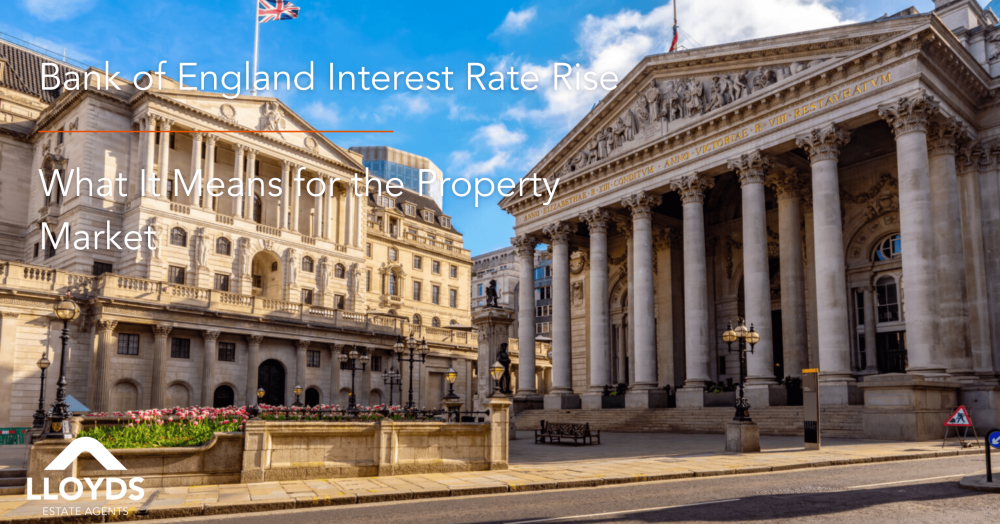
The Bank of England has raised interest rates to 4%. We look at what the decision means for mortgages, buyers, sellers and the UK property market.
Bank of England Raises Interest Rates to 4% – What Does It Mean for Homeowners and the Property Market?
The Bank of England has announced an increase in the UK's base interest rate today (5 November), raising it from 3.75% to 4%.
The decision, made by the Bank's Monetary Policy Committee (MPC), represents the first increase in more than three years and comes against a backdrop of rising inflation, largely driven by higher energy prices and ongoing uncertainty in the Middle East.
While the announcement may be disappointing news for homeowners and prospective buyers who were hoping to see borrowing costs fall further, it's important to put the decision into perspective. A 0.25 percentage point increase doesn't necessarily mean a significant change to the property market, nor does it mean we're entering a prolonged period of rising interest rates.
So, what has prompted the decision, and what does it mean if you're thinking about buying or selling a property?
Why have interest rates increased?
The main concern for the Bank of England is inflation.
The UK's inflation rate rose to 3.5% in September, moving further away from the Bank's target of 2%.
A significant factor behind this increase has been rising global energy prices, with disruption linked to the conflict in the Middle East pushing up the cost of fuel and household energy bills.
The Bank is concerned that these higher costs could gradually feed through into other areas of the economy, including the prices businesses charge and the wages they pay.
Increasing interest rates is one of the tools available to the Bank to help control inflation. Higher borrowing costs generally encourage households and businesses to spend less, helping to reduce demand and, ultimately, the pressure on prices.
The decision was supported by eight of the nine members of the Monetary Policy Committee, with one member favouring a larger increase to 4.25%.
However, the Bank has been keen to stress that today's decision should not automatically be interpreted as the beginning of a long sequence of rate rises. Future decisions will depend on how inflation, energy prices and the wider economy develop.
What does this mean for mortgage rates?
For homeowners with a mortgage, the impact will depend largely on the type of mortgage they have.
If you're on a tracker mortgage, your interest rate is generally linked to the Bank of England base rate. In most cases, today's increase will mean your monthly repayments rise, although the exact amount will depend on your mortgage balance and terms.
If you're on a standard variable rate (SVR), your lender may choose to increase its rate, although this isn't always automatic.
If you're on a fixed-rate mortgage, there should be no immediate change to your existing monthly repayments. Your rate is fixed for the agreed period, regardless of changes to the Bank's base rate.
It's also worth remembering that fixed mortgage rates don't simply follow the Bank of England base rate. They are influenced by wider financial markets and lenders' expectations of where interest rates are heading.
This means mortgage rates can move independently of the base rate, sometimes changing before the Bank makes an announcement.
For buyers currently looking at mortgage products, there is no need to panic or assume that every mortgage deal will suddenly become more expensive.
Is this bad news for the property market?
Not necessarily.
Interest rates are an important consideration for anyone buying or selling a home, but they are only one part of the bigger picture.
The property market has continued to function through periods of much higher borrowing costs, and buyers have gradually adapted to a different mortgage environment.
Affordability, property prices, household confidence and the availability of suitable homes all play an important role in determining market activity.
Today's increase may make some buyers a little more cautious, particularly those who are stretching their budgets. However, it doesn't remove the underlying demand from people who need to move, whether that's for more space, a growing family, a change in circumstances or a new chapter in life.
For sellers, realistic pricing remains particularly important. Buyers are generally well informed and are paying close attention to monthly mortgage costs, so properties that are sensibly priced and presented well will continue to attract interest.
Could interest rates rise again?
This is perhaps the biggest question following today's announcement.
The Bank of England has indicated that further decisions will depend on how the economic picture develops, particularly whether higher energy costs begin to create more persistent inflation across the wider economy.
There is no guarantee that rates will increase again, but equally, further reductions shouldn't be taken for granted in the short term.
The next few months will be important as the Bank assesses inflation, wage growth, energy prices and the strength of the UK economy.
The next scheduled interest rate announcement is due on 17 December.
Our thoughts at Lloyds Estate Agents
While today's announcement isn't quite the news borrowers would have been hoping for, we wouldn't view it as a reason to put moving plans on hold.
The property market has always had to adapt to changing economic conditions, and buyers and sellers will continue to make decisions based on their own circumstances rather than one individual interest rate announcement.
If you're considering buying, selling or simply trying to understand what your property might be worth in the current market, having the right advice and a clear understanding of your options is more important than ever.
At Lloyds, we believe in keeping things straightforward, offering honest advice and helping people make informed decisions without unnecessary pressure.
If a move is on your mind, we're always happy to have a chat.